


There’s no question the Cleveland Museum of Art has delivered the goods with its big fall show on the influence of the Italian Renaissance on modern and contemporary Italian couture.
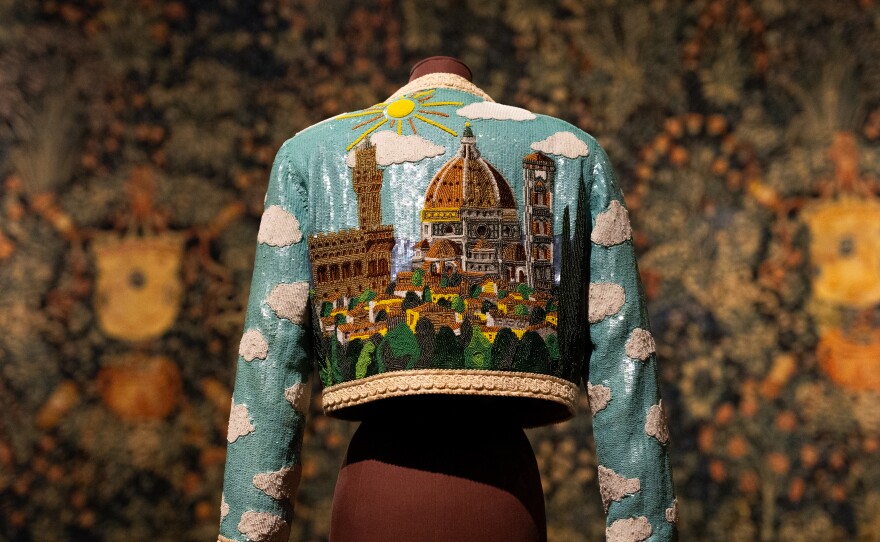
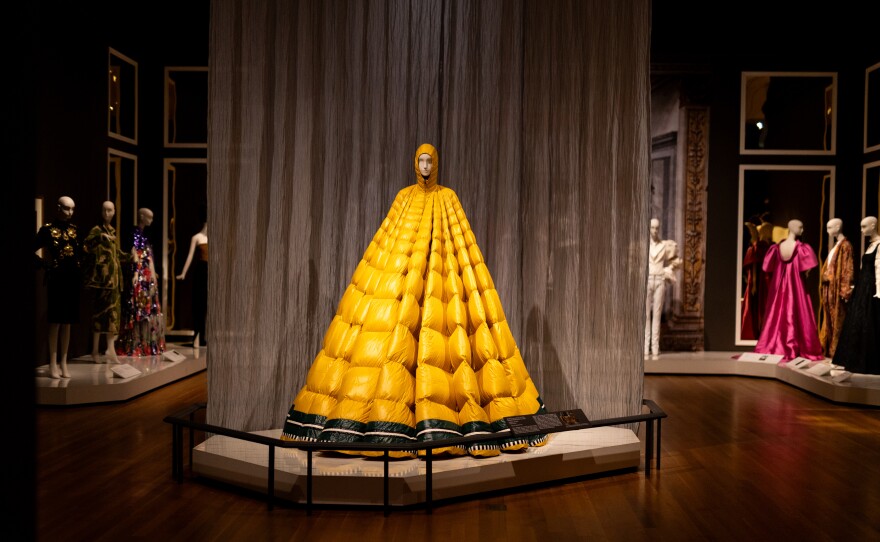
Roughly 80 garments and accessories designed by many of the big names in Italian fashion are on view, from Gucci and Pucci to Armani, Versace, Valentino, Ferragamo, Max Mara and Missoni. From ball gowns to body-hugging bodices and billowing puffer coats, the show is a virtual runway of captivating moments.
Yet for a show that emphasizes the idea of beautifully clad bodies moving elegantly through space with supreme confidence, the exhibition includes moments of questionable pacing, spatial choreography, and the relationship between labels and the works they describe.
None of the glitches, however, including those explored later in this article, are fatal. On balance, the show makes a credible case that fashion can be high art and deserves to be taken seriously by art museums and audiences. That’s what counts most.

The exhibition playfully emphasizes its main points immediately in its first room with a wordless digital video loop, more than two minutes long, projected on a wall the size of a movie screen.
Invading the museum
Created by filmmaker Francesco Carrozzini and photographer Henry Hargreaves, the installation uses AI technology to blend images of models wearing garments on display in the adjacent galleries with artworks from the museum’s permanent collection that come alive through animation.
The models are shown invading the museum, startling a security guard seated in front of a wall of screens taking remote feeds from security cameras. The “invasion’’ metaphor encapsulates how fashion could be seen as shaking up a local art museum and perhaps other institutions, including the Catholic Church.
The video toys humorously with images of a serpent chasing a startled Eve from the Garden of Eden, and black smoke issuing from the Vatican, indicating a failed vote for a new pope. In another scene, a lovely model lights a votive candle in a church before striding toward an altar that bursts into flames as she raises her arms in a gesture of triumph.
As the video suggests with the wink of a Cupid lookalike, fashion has a pervasive cultural power that ignites passions like a proverbial arrow to the heart. The Cleveland museum is not alone in recognizing such feelings. The Metropolitan Museum of Art just announced, for example, that it’s moving exhibits from its Costume Institute upstairs from basement galleries to a prime spot just off its Grand Hall main entrance lobby.

The Cleveland show, shaped by fashion Curator Darnell-Jamal Lisby, is the latest in a series of recent exhibitions organized by him and/or other curators that have explored topics including Egyptomania, Black fashion design and photography, and Korean couture.
The main thrust of “Renaissance to Runway: The Enduring Italian Houses,” as the new show is titled, is that many of Italy’s leading post-World War II design houses have taken inspiration from styles developed by designers and depicted by artists from the 1400s to the 1600s during the Renaissance and the Mannerist and Baroque periods that followed.
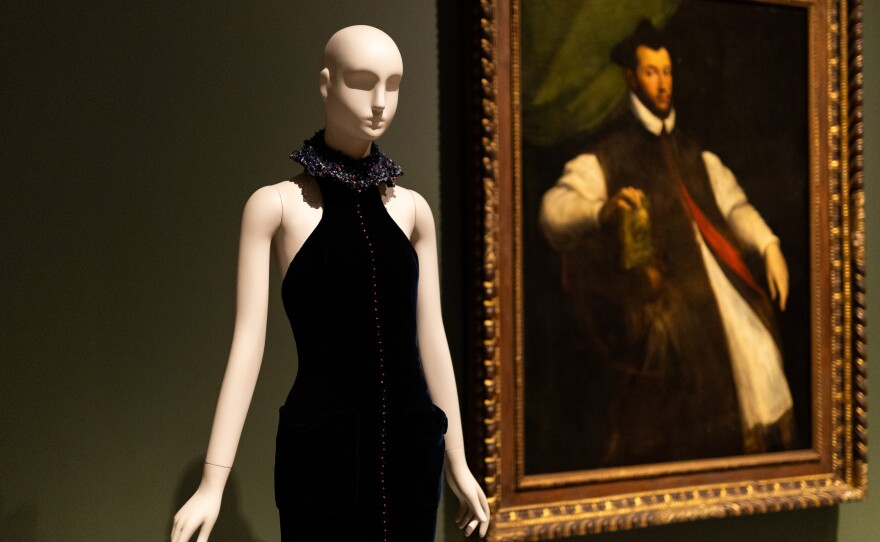
To illustrate the influence of art history on fashion, the show juxtaposes styles created by the modern and contemporary designers with more than 40 paintings, textiles, manuscripts and works of decorative art from the museum’s permanent collection and reproductions of other works in Italy.
Those examples include:
- A frilly gown designed in 1989 by Roberto Capucci, with a tight, pointed bodice that echoes lines in an imposing jeweled silk gown and mantle worn by a noble Genoese woman in a 17th century portrait from the museum’s collection by Antony van Dyck.
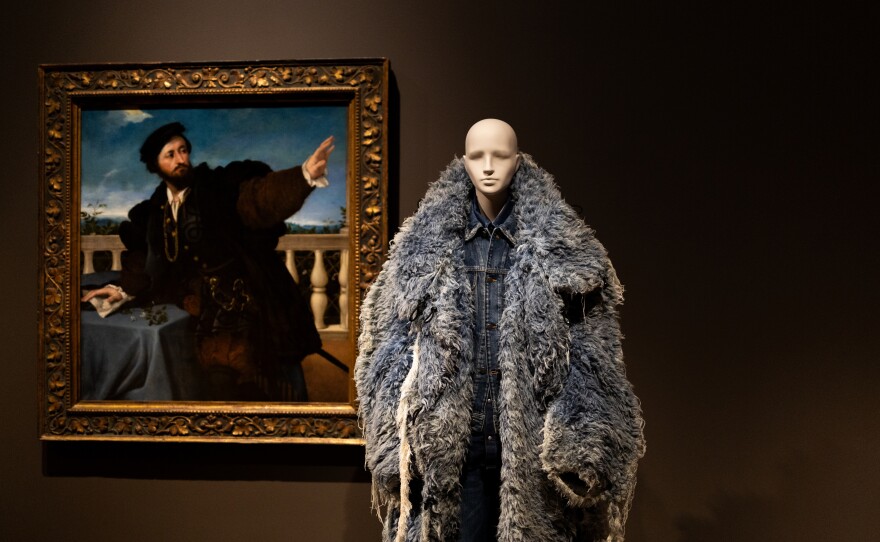
- A fluffy coat of shredded denim, created in 2022 by Belgian designer Glenn Martens for the Italian fashion house Diesel. It rhymes with the billowing contours of a padded, fur-lined coated worn by the man portrayed in a 16th century portrait in the museum’s collection by Lorenzo Lotto.
- A 2018 gown by Donatella Versace, made with plates of metal mesh resembling medieval armor. It is displayed in front of a wall-size reproduction of a 1565 Giorgio Vasari fresco of armored combatants fighting in the Battle of Marciano, painted for Cosimo I de’ Medici in the Salone del Cinquecento, or grand meeting hall, in the Palazzo Vecchio in Florence.
The connections drawn between art history and fashion are so strong that some viewers might think mistakenly that the actual artworks in the museum’s collection were direct inspirations for the fashions on view. That’s not the case.
It was Italian Renaissance in general that inspired the fashion designers, along with specific works in Italy, such as Sandro Botticelli’s “Birth of Venus’’ and “Primavera,’’ both mainstays of the Gallerie degli Uffizi in Florence, and both of which are also reproduced in the Cleveland show.
Looking good
As Lisby states in the show’s catalog, looking good during the Renaissance was an urgent matter of etiquette, presence and power for merchants, bankers, prelates, dukes and courtiers in the days of Leonardo, Michelangelo and Machiavelli.
Lisby cites the Italian word sprezzatura, to summarize the centrality of fashion in Italian consciousness. The term was coined by the 16th century writer Baldassare Castiglione, who used it to describe qualities of effortless elegance and grace that were essential for career-minded courtiers or ambassadors, like himself.
Italy at the time was a diverse collection of independent city states or imperial possessions at various times of Spain, France and the Holy Roman Empire. The country unified in 1861, bringing its diverse regions together for the first time under a single crown with a national consciousness.
As Lisby recounts, Italy emerged from World War II with fashion and design as key elements of its phoenix-like economy. By drawing on inspiration from Renaissance-era fashions, postwar designers trumpeted Italy’s national identity in a celebratory, nonthreatening way that veered from its recent fascist past.
The juxtapositions of art and fashion in the museum’s show are so clear that at first glance, they hardly need explaining in labels and wall texts. Nevertheless, the approach to verbiage in the exhibition feels at times minimal to a fault.

Some caveats
At the show’s entrance, visitors are channeled toward the wall-size video display in a way that subtly encourages them to bypass the exhibition’s introductory text, which is printed at the bottom of an immense banner on a wall in a part of the museum’s lower lobby that’s away from the direct path into the show. The text explains that the show is the biggest ever devoted to fashion at the museum, but few people are likely to see the message there.
Inside the show, the content unfurls in ways that can feel abrupt and at times perplexing. The video installation is exciting and compelling, but the introductory room could have included mini-profiles of Italy’s major fashion houses, a paragraph or two about the show’s intentions, and perhaps a map of Italy to remind viewers where major cities are located. Yet the only piece of wall text in the room refers to the pulse beat of the musical score for the video. That looks and feels odd.
Inside the next room, visitors dive right into display cases filled with Renaissance artworks, textiles and decorative objects from Florence, Genoa and Venice of the kind that inspired the modern fashions shown alongside them.
It isn’t until much later in the show that a wall text, headlined “Artistic Impressions,’’ summarizes how Renaissance art influenced modern and contemporary Italian fashion. The message would have made more sense near the show’s beginning.
A number of labels include teeny-tiny reproductions of paintings that may have inspired the fashions on view. Many viewers will find the little images frustratingly small.
Awkward moments like these are uncharacteristic for the museum, which has a long, well-deserved record of excellence in exhibit design and presentation. Most visitors probably won’t be troubled by them. To the contrary, the show seems to hum with an appreciative energy. It’s easy to eavesdrop on viewers engaged in deep discussions about stitching or the drape of a silhouette.
It's also easy to see why some visitors are coming to the show dressed up, as they would for one of the monthly MIX cocktail events in the museum’s big atrium upstairs. The exhibition is a place for people watching, for seeing and being seen, and some visitors are enthusiastically coming prepared.
They have included Clevelanders Miranda Richmond, a librarian in Lake County, and Eddie Kerekes, the sports information director at Case Western Reserve University.
Richmond wore a black skirt and leggings, butterscotch leather boots and a shimmering gold top accessorized with a pale pink leather handbag.
“I paired this all together because I wanted to bring out the gold, which I felt would be a theme throughout this exhibition,’’ she said.
Kerekes wore a black suit with a double-vented jacket and high-notched lapels over a Hawaiian short with greenish tones. Both he and Richmond said they made an effort to look good while perusing a show that was, after all, about fashion.
“I do appreciate fashion, so I was excited when they were bringing this exhibit specifically here,’’ Richmond said.

Such sentiments ought to be catnip for a museum seeking to broaden its reach and its audience. The message that fashion can be high art is coming across, loud and clear. That vindicates what Lisby and the museum are trying to accomplish. With just a tad more attention to details, Renaissance to Runway would be as flawless as the designs on view.
